Frequently Asked Questions
Below you will find information that might help you understand how to find things or learn about information you might need to know about your city or town.
Commissioner of the Revenue
7-
Commissioner of the Revenue
Contact the Commissioner of the Revenue
Address: 144 North Sycamore Street - Petersburg, VA 23803
Telephone: 804-733-2317
Commissioner of the Revenue webpage
Commissioner of the Revenue Staff Directory
CLICK HERE FOR APPLICATION FOR REAL ESTATE TAX RELIEF FOR THE ELDERLY OR DISABLED
-
Commissioner of the Revenue
No. The City of Petersburg has adopted the file by exception procedure beginning January 2014. Taxpayers will no longer be required to file a personal property filing form with the Commissioner of the Revenue Office if there have not been any changes.
The owner of the vehicle must file an initial form upon acquiring a vehicle or moving into the city.
Thereafter, the taxpayer only needs to notify the Commissioner of the Revenue if he or she disposes of the vehicle or moves out of the city.
File by Exception as of January 1, 2014:
You are no longer required to file a personal property return with the City of Petersburg by March 31st of each year . The city has adopted the “File by Exception ” procedure.
In other words if you have not changed vehicles, purchased a new vehicle, boat, trailer or motorcycle or disposed of a vehicle or had a change of address, you are no longer required to file a return every year. You are required to file a personal property form within 30 days if you:
(a) Recently purchased a vehicle or recently moved into the city
(b) Disposed of a vehicle (junked, traded, donated or sold)
(c) Moved vehicle out of the city
(d) Made an address change
If not notified within 30 days, a 10% late filing penalty will be assessed and added to your personal property taxes. The filing form is available HERE
Excess Mileage Adjustment
To claim an excessive mileage adjustment you must provide the most recent inspection slip for the vehicle for which you request the adjustment. If you claimed a mileage adjustment in 2012, it is not necessary to send in an inspection slip each year, we keep the information on file.
For further information contact:
Commissioner of the Revenue
Brittany C Flowers
804-733-2315
bflowers@petersburg-va.org
-
Commissioner of the Revenue
Yes, the City of Petersburg prorates personal property taxes. The refund is based upon the length of time that the automobile was not owned. You must first notify the DMV and contact the Commissioner of the Revenue at 804-733-2315.
-
Commissioner of the Revenue
No. You must provide your January Leave and Earning Statement for the tax you are being billed. If your vehicle is jointly owned with your spouse, they are required to complete a Spouse Affidavit stating that they are not a resident of Virginia.
-
Commissioner of the Revenue
If you moved from a prorating locality, yes.
You should notify the locality you moved from that you no longer live there and also notify DMV of your change of address.
If you moved from a locality that does not prorate, Petersburg will bill you as of January 1 of the following year.
-
Commissioner of the Revenue
Yes. The business license fee is $5.00 per day. You are limited to four yard sales per year.
-
Commissioner of the Revenue
Yes. You must apply for a home occupation permit from the Department of Planning and obtain a business license from the Commissioner of Revenue.
City Treasurer
1-
City Treasurer
If you have been assessed incorrectly on your personal property bill, please contact the Commissioner of the Revenue’s Office at 804-733-2315.
If you have been assessed incorrectly on your real estate bill, please contact the City Assessor’s Office at 804-733-2333.
If you have been assessed or billed incorrectly on your water / sewer or wastewater bill, please contact the Utility Billing and Analysis Department at 804-733-2349.
Facility Management
5-
Facility Management
Between the hours of 8:30 a.m. and 5:00 p.m., please contact the Facility Management Division’s (FMD) Administrative Office at 733-2411.
For emergencies after work hours, please contact 732-4222.
-
Facility Management
Emergencies are issues including, but not limited to: roof leaks, flooding, plumbing failures, structural damage, loss of power or other issues that affect your safety or those around you.
-
Facility Management
Use this link to report a concern. Residents can also call the Grass Hotline at 804-324-5748.
-
Facility Management
Contact Central Virginia Waste Management Authority at 804-425-0500.
-
Facility Management
Call the Facility Management Division (FMD) Administrative Office at 733-2411 or email us at fmd@petersburg-va.org to put in a service request.
Engineering
1-
Engineering
Please call our Street Operations Division at 804-733-2415 to report standing water or storm drain issues.
Hours of operation are Monday through Friday, from 8:30am to 5pm.
Petersburg Area Transit
2-
Petersburg Area Transit
Please call 804-733-2450.
-
Petersburg Area Transit
Please call 804-733-2460 for information about transferring routes.
Billing and Collections
8-
Billing and Collections
Payments are due quarterly. Options for tax payments include:
- Pay Online Here
- There is a 3% convenience fee with credit cards. There is no convenience fee for paying by check electronically. The online payment site is available 4 a.m. to 11 p.m. Daily.
- In-Person: Fiscal Management Office: 144 N. Sycamore Street, Petersburg
- Monday - Friday: 9:00 a.m. - 4:30 p.m.
- Saturday & Sunday: Closed
- Dropbox: You are able to drop off your payment at any time to the drop box located at 144 N. Sycamore Street. Payments dropped off are collected and processed the following business day.
- Mail: All Payments may be mailed to the following locations:
- Personal Property: P.O. Box 1271 Petersburg, VA 23804
- Real Estate: P.O. Box 1271 Petersburg, VA 23804
- Utilities: P.O. Box 1271 Petersburg, VA 23804
- Miscellaneous: P.O. Box 1271 Petersburg, VA 23804
For Questions regarding payments please email: CityCollector@Petersburg-va.org or call 804.733.2349
- Pay Online Here
-
Billing and Collections
Contact the Treasurer’s office, First Floor of City Hall, 135 N Union St., Petersburg, VA 23803, or telephone (804) 733-2322.
-
Billing and Collections
Contact the Treasurer’s office, First Floor of City Hall, 135 N Union St., Petersburg, VA 23803, or telephone (804) 733-2322.
-
Billing and Collections
The city has new rates that were approved by City Council to meet necessary changes and upgrades for the utility infrastructure.
View PDF version of current rates HERE
-
Billing and Collections
When submitting a garden meter adjustment it MUST have the following:
- Pictures of the meter for the previous month and current month
- Account number
- Date it is being submitted
In order for your garden meter to be applied it MUST be turned in between the 1st and 10th of every month.
Your adjustment must be worth $6 or more to be adjusted on your bill, if it is not, we will collect them until you reach the minimum amount.
If you email them or have any questions, please send to citycollector@petersburg-va.org.
-
Billing and Collections
The Office of Billing and Collections is located at 144 N. Sycamore Street.
Hours:
Monday - Friday: 7:30 am - 5:00 pm
Saturday/Sunday: Closed -
Billing and Collections
Utility bills are due on the 5th of the month.
The City reserves the right to revisit this schedule due to continued and/or unforeseen impacts of COVID-19.
We appreciate the patience of our community as we strive to preserve the safety of both our residents and employees.
-
Billing and Collections
While vehicle owners no longer need to display a decal in the front window (effective since June 11, 2018), residents with personal property will be charged a registration fee due at the time of the second half of personal property taxes.
Background: Petersburg City Council voted and approved to eliminate the physical vehicle decal and distribution of the decal effective June 11, 2018. A public hearing on this was topic was held on February 6, 2018.
Street Operations
2-
Street Operations
Call the Central Virginia Waste Management Authority hotline at 804-425-0500.
-
Street Operations
Grass and weeds in excess of (12) inches may be in violation of Petersburg City Code 50-63, 98-22 or 98-126.
If you believe there is a violation of this section, please use this link to report a concern. Residents can also call the Grass Hotline at 804-324-5748.
City Assessor
4-
City Assessor
The real estate tax rate is set each year by the City Council. The current tax rate is $1.27 per $100 of assessed value.
-
City Assessor
The new GIS website can be accessed HERE.
If you have an immediate GIS or mapping need please contact the City Assessor’s Office at 804-451-0097 Ext. 4335.
-
City Assessor
Tax maps, sewer maps, utility maps, and miscellaneous maps are located in the Office of the City Engineer
Address: 1340 E. Washington Street - Petersburg, VA 23803
Telephone: 804-733-2355
Click here for Engineering webpage
Click here for Engineering Staff Directory
**Currently, City Offices are closed to the public due to the COVID-19 Pandemic. Please call the Engineering Office before scheduling a visit.**
-
City Assessor
Click here for applications and forms
Exemptions by Classification and Designation
Certain real estate owned by religious, educational, and charitable organizations may be exempt from taxation. Real property exemptions are authorized by the Constitution of Virginia, Code of Virginia § 58.1-3600-3651. Exemptions fall into two categories. Exemption by "Classification" relates to property used for such uses as schools, houses of worship, or volunteer fire departments: Exemptions by "Classification" are administratively processed by the City Assessor’s Office. All requests for Exemption by Classification should be made by making application with the City Assessor’s Office.
Exemptions by "Designation" relate to property used for purposes, and by organizations, not specifically "classified" in the Constitution of Virginia or Code of Virginia. Exemptions by "Designation" must be approved by the City Council: There is currently a moratorium on exemptions by "Designation" in effect.
Rehabilitation Tax Credit Program – Encouraging Rehabilitation
The City Assessor’s Office administers a program to encourage both homeowners and businesses to rehabilitate their properties and in return not pay full taxes on those improvements for a period of five years. The program is authorized by the Code of Virginia § 58.1-3220 & § 58.1-3221. The program criteria varies slightly between residential and commercial properties, as well as between certain areas of the City: Please see the an application for the current criteria. The exemption commences July 1st of the tax year immediately following completion of rehabilitation. The exemption is calculated at 100 percent of the rehabilitation credit for five years. An application must be filed prior to any renovations being started. Application fees are $125 for residential properties and $250 for commercial properties.
Land Use Program – Agricultural, Horticultural & Forest Land
The Land Use Assessment Program is provided for in the Code of Virginia § 58.1-3230-43 and allows localities to offer a program of special assessments for agricultural, horticultural and forest lands. Properties that qualify for this program are assessed on the value of the land for their production rather than fair market value. The purpose of the program is to encourage the continuation of farming and forestry. Various criteria, qualifying conditions and restrictions exist for acceptance and continuation in the program.
Initial applications ($500 application fee) and annual revalidation applications must be filed by May 1 for July 1. A revailidation application fee of $500 is charged once every six years. Late initial applications and late revalidation applications may be filed from May 2 through June 30 with a $550.00 late application fee.Damage Tax Abatement
In accordance with the Code of Virginia § 58.1-3222 property owners may be eligible for a real estate tax adjustment if they have been unable to use their home or a building for more than 30 days due to damage by a fortuitous happening beyond the control of the owner. The adjustment is based on the time period the building is unfit for use or occupancy. To qualify, property owners must meet all of the following criteria:
- The destruction or damage to the building decreases its assessed value by $500 or more.
- The damage causes the building to be unfit for use or occupancy for 30 days or more.
The owner of the property files a Real Estate Tax Abatement Application within 6 months from the date of the damage.
All requests for real estate tax abatements should be made by filing a Real Estate Damage Tax Abatement Application. Submission of the application to the City Assessor’s Office will be followed by an initial inspection by the City of Petersburg Code Compliance to determine if the building is unfit for use and habitation. It is the responsibility of the property owner to notify the City Assessor’s Office when the building has been made fit for use and habitation again.
If the application is approved after the follow-up inspection, an adjusted tax bill will be computed according to the ratio which the portion of the year the building was fit for use, occupancy and enjoyment bears to the entire year. The bill will be adjusted by the Treasurer.
Conservation Easements
The placement of a conservation easement or preservation easement on a property may reduce the real estate tax liability as a result of the diminution of the assessed value. Information on conservation easements and preservation easements is available from organizations such as the Virginia Outdoors Foundation, Nature Conservancy and the Commonwealth of Virginia’s Division of Historic Resources.
Human Resources
7-
Human Resources
You can view information about available jobs by viewing our Employment Opportunities.
-
Human Resources
Applicants can come to the Department of Human Resources to use computers (no printing or flash drive capabilities) at 3811 Corporate Road in Petersburg or visit the Petersburg Public library.
Contact the Human Resources Office: 804-733-2348, HR@petersburg-va.org
**Options may have changed due to the COVID-19 Pandemic**
-
Human Resources
New job openings are released as needed.
-
Human Resources
Once a closing date has passed, no additional applications will be accepted.
-
Human Resources
You will be contacted by a department representative to schedule the date and time.
-
Human Resources
The job requirements such as education levels and years of experience are listed in each posting.
In order for an applicant to be considered for employment, they should meet or exceed the general job requirements.
You should include not only paid work experience, but all other experience which may apply to the job (i.e., volunteer experience, licenses, professional affiliation, classes you have taken, training you have received and any other special qualifications).
Failure to include information requested could result in the rejection of your application. With accurate and complete information, we will determine whether you meet the minimum qualifications for the job.
-
Human Resources
Once an application has been submitted, you cannot go back and change any information for the position applied.
However, if you need to update your contact information, you can do so by logging back into your account and clicking on the ‘Account Settings’ link under your username.
The updates will appear in your profile.
Parks & Leisure Services
5-
Parks & Leisure Services
The tennis courts lights are scheduled to come at each day - 6:00PM to 11:00PM
-
Parks & Leisure Services
The Petersburg Sports Complex is located at 100 Ballpark Road, Petersburg, Virginia 23805.
-
Parks & Leisure Services
Yes, your organization can rent a park. Please call the Parks and Leisure Services Office at 804-324-4014 or 804-324-4015 for additional information.
-
Parks & Leisure Services
Please sign up for the Notify Me Program (Recreation Alerts) - HERE
Once you register - you will begin receiving Recreation Alerts.
As soon as the City announces summer job opportunities you will receive a text or email with an Alert concerning Summer Jobs.
-
Parks & Leisure Services
The Appomattox River Park is located in the County of Dinwiddie, Virginia but the park is owned and operated by the City of Petersburg.
Virginia Power donated the land to the City of Petersburg. The park is opened from April 1st until October 31st.
Purchasing
4-
Purchasing
The City of Petersburg’s purchasing process is a combination of centralized & decentralized systems, with set thresholds that determines which solicitation method will be used.
-
Purchasing
Normally, the using department submits a requisition to the Procurement Office for a specific requirement.
-
Purchasing
Formal bids and proposals are posted on the Bid Board in the Procurement Office, posted on the Procurement Office’s website under “Bids and Proposals” and on the Commonwealth of Virginia’s electronic procurement system (eVA).
-
Purchasing
The Procurement Office has the responsibility to purchase or lease all supplies, materials, equipment, and contractual services for the use of the City and its Agencies, as needed.
Fire
14-
Fire
A fire in your home can change your life completely. Knowing where to begin and who can help you is important.
The U.S. Fire Administration has published a booklet that can help you get through this rough time.
This publication will provide you with some valuable information on what you should do after experiencing a fire in your home.
-
Fire
No, city ordinance prohibits outside burning leaves within the city limits.
-
Fire
Petersburg Department of Fire, Rescue and Emergency Services does not fill fire extinguishers.
-
Fire
You must contact us to schedule a tour.
Remember, even when tours are scheduled, the tour may be cut short or cancelled due to the station receiving an alarm and having to leave.
To schedule a tour, please contact the Public Educator @ 804-733-2328.
**Tours may be unavailable due to the COVID-19 Pandemic**
-
Fire
Every smoke alarm has a test button, usually in the center of the alarm.
Press the test button and hold it for a few seconds.
If it is working correctly, the alarm will sound and will automatically stop when you release the button.
Remember to test your smoke alarm monthly and change the batteries twice a year.
-
Fire
We recommend you change the batteries in your smoke alarms every 6 months.
An easy way to remember is to change batteries when you reset your clock for daylight savings time.
-
Fire
Most modern smoke alarms will chirp to alert you the batteries are low. You should replace the batteries and test your smoke alarm.
Smoke alarms can be purchased at any hardware or large commercial department store.
-
Fire
Smoke alarms should be placed outside each sleeping area and on every level of the home, including the basement.
On floors without bedrooms, alarms should be installed in or near living areas such as dens, living rooms, or family rooms. Remember to test the alarms regularly!
-
Fire
Homeowners should buy an extinguisher that can handle Class A-B-C fires.
This type of extinguisher is designed to extinguish fires that usually occur in homes including wood, paper, flammable liquids, and electrical fires.
-
Fire
The four basic steps in creating an escape plan for your home includes: drawing a floor-plan of your home; agreeing on a meeting place; practicing your escape plan; and making sure your exit drill is realistic.
-
Fire
Assure that you have a well-defined escape plan. Make sure that people who are confined to a wheelchair have immediate access to their wheelchair when an emergency occurs.
-
Fire
Leave the area immediately and dial 911 from a safe location!
-
Fire
The hose can be damaged and any firefighter at the end of a nozzle will have the water interrupted and possibly cause injuries or death.
Any hose that is driven over without protection has to be taken out of service and tested.
-
Fire
Call 911 immediately. Downed and arcing power lines are a very dangerous situation! Do not approach any area with downed power lines.
Animal Control
1-
Animal Control
To reclaim an animal from our custody, you will be required to present your driver’s license or photo identification. You will also be required to produce records that show the animal has a current rabies vaccination and city license.
If you do not currently have one or both, you will be required to get a rabies shot within 24 hours and purchase a city license from the City Treasurer’s Office.
Summonses may be issued for non-compliance with City Code and you may be charged for allowing your animal to run at large.
You will be required to pay the board fee of $12.00 per day for every day your animal was held at the pound. If your animal was seized for a violation of animal welfare code, the General District Court Judge will determine if the animal will be returned to your custody and/or if the issue that constituted the violation must be corrected to the satisfaction of the Animal Control Officer prior to the animal’s release or shortly thereafter.
Seizure of an animal may also include additional summonses being served such as animal cruelty code violations. You will be responsible for repaying any veterinary costs incurred on behalf of the animal while in the care of Animal Care & Control.
Voter Registration
1-
Voter Registration
Only as a mailing address and only if it is within the City limits with a zip code of 23803, 23804 or 23805.
You must provide a physical street address as the City votes by a Ward system and your physical street residence address places you into the Ward where you will vote.
There are exceptions that may legally qualify to non-publish yet requires that you meet certain statutory requirements for Law Enforcement, court ordered protective orders, or registered with Attorney General’s address confidentiality program.
Community Corrections
10-
Community Corrections
The purpose of Pretrial Services is to assist Judicial Officers in discharging their duties and in making bail release decisions or in reviewing and amending the conditions of release on bail at subsequent hearings. Pretrial Officers conduct interviews and investigations to provide better information for use by Judicial Officers.
The information helps in determining the risk to public safety and the assurance of appearance in Court of persons age 18 or over, or persons under the age of 18 who have been transferred for trial as adults held in custody and charged with an offense, other than an offense punishable by death, who are pending trial or hearing. In addition, Pretrial Services provide supervision of defendants placed in the custody of the program and assure compliance with the conditions of release imposed by Judicial Officers.
-
Community Corrections
To expedite defendant release and improve judicial decision making through the provision of defendant background information and recommendations for use by Judicial Officers in determining or reconsidering the risk to public safety and appearance in court, pending trial. To reduce failure to appears in court and improve public safety by providing custody and supervision to pretrial defendants. To alleviate jail overcrowding, thereby reducing jail operating costs and future capacity needs of local jails, caused by unnecessary detention of certain pretrial defendants. To improve the efficiency and effectiveness of local criminal justice systems.
-
Community Corrections
Individuals are placed on local probation supervision and referred to PCC by Judges in the Juvenile, General District and Circuit Courts in Petersburg and Dinwiddie as a sentencing option, and an alternative to incarceration.
-
Community Corrections
Available services to the court are: probation supervision, alcohol and drug testing, alcohol and drug screening and assessments, referrals for alcohol and drug education and treatment, anger management classes, shoplifting prevention classes, Thinking for Change (T4C) classes, restitution collection and monitoring and community service placement and monitoring.
-
Eligibility is in accordance with Virginia Code 19.2-303.3 and includes: Offenders 18 years old, or considered an adult at the time of conviction, of a misdemeanor or a non-violent felony for which the court may impose a jail sentence.Community Corrections
-
Community Corrections
A client who has a return to court date established must be supervised until the return to court date, or three months if the client has completed all court ordered requirements, whichever comes first. A client without an established return to court date, the general guideline is three months minimum for misdemeanants and six months minimum for felons. Generally, a substance abuse tested client must remain on supervision until his return to court date or six months, whichever comes first. Individuals remain on probation supervision until the Court has approved their release.
-
Community Corrections
The main conditions are as follows:
•Keep the peace, be of good behavior, and not violate any municipal, county, state, or federal laws and ordinances
•Follow PCC Officer’s instructions and be truthful and cooperative
•Do not illegally use, possess, or distribute narcotics, dangerous drugs, controlled substances, or drug paraphernalia
•Meet with their Local Probation Officer as instructed
•Comply with all court ordered requirements.
-
Community Corrections
Yes, all individuals under local probation supervision will be charged a one-time supervision/intervention fee of $150.00, unless transferred to PCC from another agency, or the fee is reduced or waived for good cause.
-
Community Corrections
It is your responsibility to contact your Probation Officer to reschedule your appointment.
-
Community Corrections
No, your assigned probation officer will assign you to an appropriate community service site and will make every effort to assign you to a site conducive to your employment/school/childcare schedule(s).
Juvenile Community Crime Control Program
2-
Juvenile Community Crime Control Program
Juveniles and their families before intake, adjudicated delinquent, Children In Need of Services (CHINS) or Children In Need of Supervision (CHINSup) through non-secure programs and services.
Traffic offenders may only be served through VJCCCA funds if their offense rises to the level of a misdemeanor or felony.
-
Juvenile Community Crime Control Program
Monday - Friday (8:30 AM - 5:00 PM)
Dogwood Trace Golf Course
1-
Dogwood Trace Golf Course
Monday - Friday: 8:00am - 5:00pm
Saturday - Sunday 7:30am - 5:00pm
View Dogwood Website HERE
**Hours may vary due to COVID-19 Pandemic**
Risk Management
2-
Risk Management
Please call the Risk Management Office at (804)733-2300 Ext 2445.
You will be asked a series of questions such as: name, date and time of incident, location of incident, description of incident, and injuries/damage sustained.
An investigation will be conducted and a claim will be submitted to the City’s Insurer.
-
Risk Management
Click HERE for the Special Event Permit Application.
Code Compliance
11-
Code Compliance
Virginia Uniform Statewide Building Code 2021 Edition (Effective Jan. 18, 2025) adopts the 2021 International Code Council’s volume of codes.
-
Code Compliance
Within the City of Petersburg, permits are required for all work except ordinary repairs.
The Building Official’s Office recommends that before any work is started that you review any permit requirements that may apply to the description of work contained in the documents below.
-
Code Compliance
Yes, Permit applications are online, please click HERE for portal.
The following information is to be used as a guide. Fees will be tabulated and must be paid when permits are issued. DO NOT SEND PAYMENT WITH APPLICATIONS.
- 1 & 2 Family Residential - .63 (5/8) % of estimated cost + $25.00 base fee (this includes garages, gazebos, decks, swimming pools, residential, demolition and all other residential construction)
- Commercial - 1% of estimated cost + $75.00 base fee (this includes hospitals, hotel/motels, radio towers, apartments, commercial demolition and all other commercial construction)
- Add 2% State tax to total permit cost
- Beginning work without a permit - $50.00
- Re-inspection fee $50.00 (due to negligence on the part of permit holder) This includes, but is not limited to:
- Scheduled inspection and work not ready for inspection
- Site secured and inspected
- Dangerous conditions
Electrical Permit Fee Schedule
- 1 & 2 Family Residential - 1% + $25.00 of estimated cost (this includes garages, gazebos, decks, swimming pools, residential, demolition and all other residential construction)
- Commercial - 1% + $75.00 of estimated cost (this includes hospitals, hotel/motels, radio towers, apartments, commercial demolition and all other commercial construction)
- Add 2% State tax to total permit cost
- Beginning work without a permit - $50.00
- Re-inspection fee $50.00 (due to negligence on the part of permit holder) This includes, but is not limited to:
- Scheduled inspection and work not ready for inspection
- Site secured and inspected
- Dangerous conditions
Mechanical Permit Fee Schedule
- 1 & 2 Family Residential - 1% + $25.00 of estimated cost (this includes garages, gazebos, decks, swimming pools, residential, demolition and all other residential construction)
- Commercial - 1% + $75.00 of estimated cost (this includes hospitals, hotel/motels, radio towers, apartments, commercial demolition and all other commercial construction)
- Add 2% State tax to total permit cost
- Beginning work without a permit - $50.00
- Re-inspection fee $50.00 (due to negligence on the part of permit holder) This includes, but is not limited to:
- Scheduled inspection and work not ready for inspection
- Site secured and inspected
- Dangerous conditions
Plumbing Permit Fee Schedule
- 1 & 2 Family Residential - 1% + $25.00 of estimated cost (this includes garages, gazebos, decks, swimming pools, residential, demolition and all other residential construction)
- Commercial - 1% + $75.00 of estimated cost (this includes hospitals, hotel/motels, radio towers, apartments, commercial demolition and all other commercial construction)
- Add 2% State tax to total permit cost
- Beginning work without a permit - $50.00
- Re-inspection fee $50.00 (due to negligence on the part of permit holder) This includes, but is not limited to:
- Scheduled inspection and work not ready for inspection
- Site secured and inspected
- Dangerous conditions
-
Code Compliance
Building and premises are to be identified with numbers visible from the street. Numbers shall be affixed to the building/premises.
Numbers shall be at least four inches high and half inch wide; their color shall contrast with the background.
It shall be unlawful for any person to remove/destroy any such number, except to repair or replace. Mail boxes do not count as property I.D.
-
Code Compliance
Each opening is to be secured in the following manner:
1. Using CD exterior grade plywood 3/8 inch thick cover the opening from inside frame to inside frame. The plywood covering shall be affixed to the inside frame of the opening,10 inches apart, using #8 or #10 nails of not less than 2 1/2 inches in length. The plywood shall be secured in such a manner that 250 pound force applied perpendicular to the plane of the opening will not remove the plywood cover from the opening.
2. In the event that storm windows or other hindrances exist, a perimeter application of 2x4 lumber shall be fixed in place. The exterior dimensions of the 2x4 lumber framing shall be fixed in place. The exterior dimensions of the 2x4 lumber framing shall not exceed the exterior dimensions of the opening to be covered. The 2x4 frame shall be affixed in such a manner that the framing will resist a 250-pound force applied perpendicular to the surface. A 3/8 inch thick plywood covering of CD exterior grade plywood shall be applied to the framing. The covering shall not overhang either the exterior dimensions of the opening or the lumber framing. The plywood covering shall be affixed either to the 2x4 framing or to the inside frame of the opening using screws of not less than 2 1/2 inches in length.
3. The exterior exposed facing of the plywood and the 2x4 framing shall be painted using a primer and two coats of a black exterior latex paint.
-
Code Compliance
Grass and weeds in excess of (12) inches may be in violation of Petersburg City Code 50-63, 98-22 or 98-126.
If you believe there is a violation of this section, please use this link to report a concern. Residents can also call the Grass Hotline at 804-324-5748.
-
Code Compliance
The Virginia Uniform Statewide Building Code (VUSBC) requires a permit for all swimming pools, hot tubs or spas that meet ANY of these condition:
1. Greater than 150 square feet (approximately 7’ in diameter).
2. With more than 5000 gallons of water.
3. Deeper than 24"
The International Residential Code (IRC) does not distinguish between in-ground or aboveground, indoor or outdoor swimming pools. The code required spas and hot tubs to conform to the same requirements as swimming pools. Pools for (fish or flora) landscaping are exempt from this section regardless of the size.
Swimming pool and barrier permit application can be found HERE.
-
Code Compliance
The exterior of a building shall be maintained in good repair and structurally sound.
Included, but not limited to: doors, windows, frames, porches, balconies, trim and decks, gutters, downspouts, flaking and peeling paint, structural members, roots, stairway, rails, rotting, and decaying wood.
-
Code Compliance
A site plan is a drawing that shows an interested party what the development plans are for the land.
Site plans are required for a property if the following situations apply:
- New Structure on vacant lot
- Addition to existing structure
- Accessory Structure
How the Review Process Works
After the application and construction documents have been submitted:
- Plan reviewers from all applicable departments will review the submitted plans and documents to evaluate code and ordinance compliance:
- Building Inspections – reviews application and plans for code compliance.
- Planning - reviews plot plan for setbacks, easements and zoning compliance
- Utilities – reviews plot plan and application for water and sewer availability, and encroachments into water and sewer easements
- Environmental Engineering – reviews plot plan for erosion control, drainage, and Chesapeake Bay Act, as well as setbacks from all easements and environmental features.
- Fire Marshal - for fire suppression systems/ site plan for fire code compliance.
- Budget Management – reviews application for proffer payments (when applicable)
- Health (when applicable)
- If the construction documents are approved, the permit may be issued.
- If corrections are required:
- By Plan Review - the plans are placed on “hold” and the applicant is notified by telephone or email (based on the alternative selected at the time the application is submitted).
- By any of the other departments listed in #1 above - a letter will be mailed once the last department review has been completed.
- The applicant can meet with review staff to discuss outstanding issues.
- If necessary, the applicant takes the plans back to make the necessary changes.
- The applicant submits the corrected construction documents for re-review. Permits will not be issued until construction documents comply with the Codes.
-
Code Compliance
Lumber, trash, junk, and debris on private property may be a violation of Petersburg City Code 50-62.
If you believe that there is a violation of this section, you may visit City Code section 50-62 for more information or contact Code Compliance at (804)733-2409.
You can also submit a concern HERE
-
Code Compliance
The City uses the following lines to deem an existing structure unsafe:
- Determined by the code official to be dangerous to the health, safety and welfare of the occupants of the structure or the public.
- Contains unsafe equipment that is so damaged, decayed, dilapidated, structurally unsafe or such faulty construction of unstable foundation that partial or complete collapse is likely.
- A vacant existing structure, unsecured or open
Report an unsafe structure HERE
PIO
3-
PIO
You can sign up to receive the newsletter and City announcement alerts HERE
To receive press releases, email the Petersburg PIO at fosoba@petersburg-va.org.
-
PIO
The City’s public access channel is Channel 15 for Comcast customers.
-
PIO
Yes! The City has Facebook (@CityofPetersburgVA), Twitter (@PetersburgV), and Instagram (@Petersburg_VA). We encourage you to follow us on all of our social media accounts.
Freedom of Information Act (FOIA)
2-
Freedom of Information Act (FOIA)
Please note that as of September 1, 2019, the City of Petersburg will resume reasonable charges for FOIA requests as per § 2.2-3704.
This may include charges for any outstanding FOIA requests that have not been fulfilled.
You can find more information HERE
-
Freedom of Information Act (FOIA)
Under the Virginia Freedom of Information Act (FOIA), citizens of the Commonwealth and representatives of the media have the right to examine public records.
Utilities
1-
Utilities
Call Public Utilities at 804-324-5446 so that it can be determined if the problem is the responsibility of Public Utilities or the resident / private citizen.
Powered by Froala Editor
Backflow Prevention
21-
Backflow Prevention
The purpose of the Backflow prevention program is to protect the health and well-being of the people of the City of Petersburg by securing its water supply from harmful substances and contaminants. It is also required by the Virginia Department of Health’s (VDH) Waterworks Regulations. As the water system operator for the City of Petersburg, the City is required to have this program as a condition for the issuance of its water system operator’s license.
-
Backflow Prevention
A cross-connection is any temporary or permanent connection between a public water system or consumer’s potable (i.e., drinking) water system and any source or system containing nonpotable water or other substances. The piping between the City’s water system or consumer’s potable water system and an auxiliary water system (such as those associated with wells, cooling systems, or irrigation systems) is an example of a potential cross-connection. See Figure 1 for an illustration of a cross-connection.
Figure 1 – An example of a potentially harmful cross-connection (Image Credit: American Water Works Association)
-
Backflow Prevention
Backflow is the unfavorable reversal of flow of nonpotable water or other substances into the piping of a public water system or consumer’s potable water system, through a cross-connection from one to the other. The two types of backflow are backpressure and backsiphonage.
-
Backflow Prevention
Backpressure is backflow caused by a downstream pressure that is greater than the upstream or supply pressure in a public water system or consumer’s potable water system. Backpressure can result from an increase in downstream pressure, a reduction in the potable water supply pressure, or a combination of both. Increases in downstream pressure can be created by pumps, temperature increases in boilers, etc. Reductions in potable water supply pressure occur whenever the amount of water being used exceeds the amount of water being supplied, such as during water line flushing, fire fighting, or breaks in water mains. Figure 2 shows how a backpressure scenario can occur.
Figure 2 – A superior pressure in a nonpotable system (the chemical storage tank) pushes harmful pollutants into the potable water supply when the valve is left open with the compressor on (Image Credit: AWWA)
-
Backflow Prevention
Backsiphonage is backflow caused by a negative pressure in a public water system or consumer’s potable water system. Negative pressure is also known as a vacuum or partial vacuum: in similar fashion to drinking water through a straw, backsiphonage can draw harmful contaminants and pollutants in one water system to flow out to another’s, to great negative result. Backsiphonage can occur when there is a stoppage of water supply due to nearby firefighting, a break in a water main, routine maintenance flushing, or any other situation that causes a significant loss in water system pressure. Figure 3 shows how a backsiphonage scenario can occur.
Figure 3 – As firefighters combat the fire across the street, this depletes the water supply below. This reduces the pressure in the supply line below atmospheric pressure, creating a siphon that can draw pollutants and contaminants from the local water system to the greater water supply (Image Credit: AWWA)
-
Backflow Prevention
Backflow into a public water system can unleash pollutants or contaminants into the system’s water, rendering the water unpleasant and potentially unhealthy for the City’s residents. The City has a responsibility to provide water that is safe to drink in all foreseeable circumstances. For these reasons, the City must take reasonable precautions to protect its public water system against backflow.
-
Backflow Prevention
Only residential homes that have irrigation, sprinkler systems, boilers, geothermal heating systems or medical equipment connected to the City’s water system are required to have backflow prevention assemblies on those systems. Residential homes that do not have these systems on their property are not required to have backflow prevention assemblies installed.
-
Backflow Prevention
Irrigation systems include but are not limited to agricultural, residential, and commercial applications. The VDH classifies lawn sprinkler systems and irrigation systems as a high hazard; sprinklers, bubbler outlets, emitters, and other equipment are exposed to substances such as fertilizers, fecal material from pets or other animals, pesticides, or other chemical and biological contaminants and pollutants. Sprinklers may remain submerged underwater after use or storms. Should the water system pressure suddenly decrease, such as in the case of a water main break, line flushing, or during a major fire involving multiple fire hydrants, these harmful substances can be back-siphoned into the water distribution system. They may be subject to various onsite conditions such as additional water supplies, chemical injection, booster pumps, and elevation changes. All of these conditions must be considered when determining backflow protection. Some hazards relating to irrigation systems are:
Fertilizers: Ammonia salts, ammonia gas, phosphates, potassium salts.
Herbicides: 2,4-D, dinitrophenol, 2,4,5-T, T-pentachlorophenol, sodium chlorate, borax, sodium arsenate, methyl bromide
Pesticides: TDE, BHC, lindane, TEPP, parathion, malathion, nicotine, MH and others
Fecal matter: Animal (domestic and non-domestic)
-
Backflow Prevention
For those irrigation systems connected to the City’s potable water system, the appropriate protection is a Reduced Pressure Principle (RPP) backflow prevention assembly, as it protects against both high and low hazards, as well as against both backpressure and backsiphonage. While Double Check Valve Assemblies (DCVA) are common devices, they do not protect against high health hazards and are therefore not suitable for use in irrigation systems. A Pressure Vacuum Breaker (PVB) may be used for service protection if the Public Utilities Division potable water service is the sole source of supply to the premises or property, if it is used strictly for irrigation, and there is no means or potential for backpressure, as PVBs protect against backsiphonage but not against backpressure. Approved backflow prevention devices and assemblies are those which meet AWWA standards and are approved by ASSE and the University of Southern California Foundation for Cross-Connection Control and Hydraulic Research.
-
Backflow Prevention
Generally, the backflow prevention assembly is located as close as possible to the water service connection, though it must be on private property. For irrigation systems, it is usually installed outdoors and in a “loop” of the irrigation system that extends above the ground and sometimes near the sprinkler system timer.
-
Backflow Prevention
Facilities that require backflow prevention assemblies include, but are not limited to: amusement parks, auxiliary water systems, almost any kind of heavy industry, car wash facilities, cold storage plants, film laboratories, fire systems, hospitals and other medical facilities, building with irrigation (sprinkler) systems, laundromats and dye works, motion picture studios, schools, large multistory buildings, sewage and storm drain facilities, water treatment plants, wastewater treatment plants, waterfront facilities, and water-using recreational facilities such as pools or water parks. Any building where there is a risk of cross-connection to pollutants or contaminants needs a backflow prevention assembly.
-
Backflow Prevention
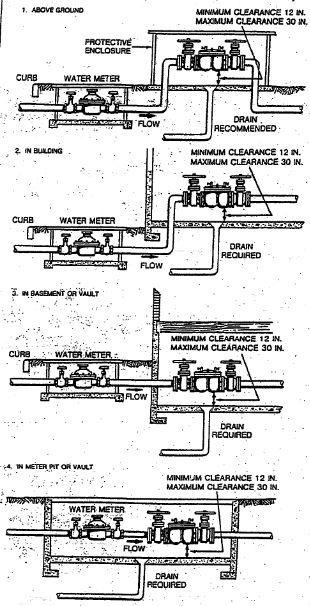
Yes, backflow prevention assemblies should be installed in accordance with the manufacturer’s installation instructions, the Uniform Statewide Building Code and any additional instructions offered by the Public Utility Division. RPP devices are installed in a horizontal position with the relief port down. They should not be installed in a pit or in any location that could experience flooding, as their functionality is impacted by submersion in fluids. To allow for easy access and maintenance, RPP devices should be installed at least 12 inches above the floor with 24-inch clearance on all sides, and should be in a location safe from freezing temperatures and vandalism. The leaking action of the relief valve should also be considered (installation above a floor drain is ideal).
Unlike RPPs, DCVAs can be installed in a pit and can be submerged but must still be protected against freezing and vandalism. Like the RPP, it should be installed horizontally and in an area that is easily accessible and with plenty of clearance for the maintenance professional to inspect and test the device.
A PVB should be installed in an easily accessible area that is at least twelve inches above the highest downstream outlet (this is necessary thanks to the PVB’s vulnerability to backpressure), and like the other devices must be protected from freezing and vandalism. The air-inlet port must never be blocked or sealed as this defeats the usefulness of the device.
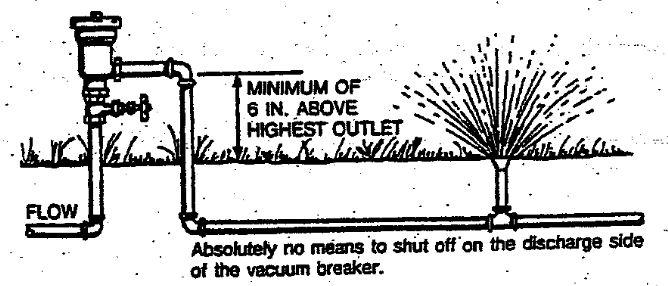
Finally, Atmospheric Vacuum Breakers (AVBs) must be installed 6 inches above the highest point of downstream outlet, the highest point of downstream usage, the highest downstream piping, and the highest flood elevation. AVBs must be installed downstream of all valves and pumps (aspirators can be used downstream of AVBs). Like all other devices, the AVB must be kept safe from freezing temperatures and vandals, and like the PVB the assembly’s air inlet port should never be blocked or sealed. Figures 4, 5, 6, and 7 display the optimal placement of the various backflow prevention assemblies.
Figure 4 – RPP placement guide (all images from AWWA) Figure 5 – DCVA placement guide
Figure 6 – AVB placement guide Figure 7 – PVB Placement guide
-
Backflow Prevention
A Plumbing permit is not required to install a backflow device, unless its installation requires disturbing city property in a manner that would require a plumbing permit. In the majority of cases it is not necessary, however.
-
Backflow Prevention
An approved Plumbing Permit is required to remove a backflow prevention device that is currently in operation. The Director of Public Works & Utilities is authorized to take whatever steps are necessary to protect the City’s water supply in the event of an unauthorized removal of a backflow prevention device.
-
Backflow Prevention
Backflow prevention devices must be tested at least annually. Backflow assemblies are mechanical assemblies and as such they are subject to fail, which is why the VDH requires that they be tested at least once a year. Newly installed backflow assemblies and backflow assemblies that are repaired or relocated must also be tested. This requirement is echoed by the Virginia Maintenance Code, International Plumbing Code, and the Environmental Protection Agency’s Cross Connection Control Manual. Only certified individuals may perform inspections and tests of backflow prevention assemblies – see here.
-
Backflow Prevention
Though the Division of Public Utilities monitors the installation and maintenance of these assemblies as required by the VDH, the City of Petersburg does not have any influence or control over the contractor’s pricing, and it can vary from one testing contractor to another. Currently the prices range from $85 to $200. Group pricing, whether through a neighborhood or homeowner’s association is an option that may lower your annual testing cost. Combining the test with other irrigation system maintenance may also net a savings for the homeowner.
The City of Petersburg Division of Public Utilities does not endorse, guarantee, or warrant any work performed by the testing contractors. All interactions between customers and contractors are private transaction between these two entities.
-
Backflow Prevention
Per the Virginia Administrative Code 12VAC5-590-630, in order to be certified to inspect and test a backflow prevention assembly, an individual must apply here to take the examination to be a backflow prevention device worker. They must also have documentation showing that their test kit has been calibrated within the last year.
-
Backflow Prevention
Yes, the City tracks the backflow assembly information in our data base which will generate a reminder letter to our customers reminding them when their annual test is due. You should receive a reminder letter 30 to 45 days before your test is due. If you do not receive a letter, please contact the Program Coordinator at 804-835-0928 or hwingfield@petersburg-va.org.
-
Backflow Prevention
The absence of a reminder letter does not void the requirement of the annual inspection required by the Division of Public Utilities. There is general information (including this F.A.Q.) and a copy of a blank test form on the City’s website. If you have not received a letter, please contact the Program Coordinator at 804-835-0928 or hwingfield@petersburg-va.org and provide him with the information necessary so we can send you the annual testing notifications.
-
Backflow Prevention
The completed test form must be submitted to the City’s Division of Public Utilities either via email to hwingfield@petersburg-va.org or hand-delivered or mailed to:
City of Petersburg Division of Public Utilites
C/O Hall Wingfield
1340 E Washington Street
Petersburg, VA 23803Please retain a copy of the test form for your records as required by the City Code of Petersburg and state law.
-
Backflow Prevention
AVB – Atmospheric Vacuum Breaker
AWWA – American Water Works Association
DCVA – Double Check Valve Assembly
PVB – Pressure Vacuum Breaker
RPP – Reduced Pressure Principle Device
VDH – Virginia Department of Health



Planning and Community Development
11-
Planning and Community Development
The Planning Department cannot determine that a lot is not buildable. Whether or not a lot is “buildable” depends on what building plans are proposed, location on the property, site conditions, and what steps the owner is willing to take. If an owner submits a building permit application with building plans and a site plan, then the Planning Department will review the application for compliance with the zoning ordinance. If a property owner wishes to preview applicable zoning requirements before they submit a building permit, they will need to provide sufficient details about what they want to build and where on the property, and then a zoning official can preview what zoning ordinance requirements would apply to the proposal. Below is some of the criteria that the site plan would be judged upon:
- Lot width, area
- The different lot width, area, and setback requirements by district can be found at the following link: https://library.municode.com/va/petersburg/codes/code_of_ordinances?nodeId=PTIICO_APXBZO_ART22HEARBURE_S1REVADI
- You can find the zoning district and approximate size of your lot at the following link: City of Petersburg (geodecisions.com)
- Exceptions
- There exist exceptions for lots which don’t meet the requirements of lot width and area. These can be seen on the following document: Lot Regulations.
- Uses
- See allowed uses for your property by consulting the zoning ordinance at the link below and clicking your property’s zoning district on the sidebar.
-
Planning and Community Development
1. Applicant files petition with the Petersburg Department of Planning and Community Development, City Hall, 135 N Union Street, Petersburg, Virginia 23803.
Note: It is advised that the applicant discusses the proposed change with the Councilmember responsible for their Ward, in order to determine the likelihood that such request would be approved. To find the Councilmember responsible for our ward, consult the following links: http://www.petersburg-va.org/263/Ward-Map and https://petersburgva.gov/123/City-Council
2. The Filing fee for Petitions for Rezoning or Special Use Permits is $1,500. A Check or Money Order made payable to the City of Petersburg is to accompany the application.
Note: This fee goes towards the legally required advertising of the public hearing described below.
3. A Plat of the property must also accompany the petition. A copy of your plat may be found at the office of the Clerk of Circuit Court, 7 Courthouse Ave., Petersburg, VA 23803, or telephone 804-733-2367.
4. The Department of Planning and Community Development Staff will refer the petition to the Planning Commission to hold a public hearing and consider the petition. Department of Planning and Community Development staff shall advertise the public hearing twice during a fourteen-day period, and the Planning Commission will hold a public hearing, and make a recommendation to the City Council regarding the petition.
5. The City Council schedules then advertises a public hearing regarding the petition.
6. The City Council holds a public hearing then considers the petition with the Planning Commission recommendation and renders a final decision to approve or disapprove the petition.
-
Planning and Community Development
Uses that require a Special Use Permit can be found at the following link: https://library.municode.com/va/petersburg/codes/code_of_ordinances?nodeId=PTIICO_APXBZO_ART23SUUSREPEUS_S4SPUSEN
-
Planning and Community Development
See allowed uses for your property by consulting the zoning ordinance at the link below and clicking your property’s zoning district on the sidebar.
Mini TOC: APPENDIX B - ZONING | Code of Ordinances | Petersburg, VA | Municode Library You can also reference this use matrix for a quick glance of the uses allowable in each district.
-
Planning and Community Development
Go to City of Petersburg (geodecisions.com) and type the address of the property you’re trying to find information on.
-
Planning and Community Development
Specific businesses can be operated out of the home. This is determined by several factors, please call the Planning Office at 804-733-2308 to provide information and receive an application.
-
Planning and Community Development
For matters related to the Board of Zoning Appeals (BZA), information can be found at the following link: Board of Zoning Appeals | Petersburg, VA - Official Website (petersburgva.gov)
-
Planning and Community Development
Building setbacks and yard requirements vary by zoning district. Please consult the chart at the following link for the requirements for your district: ARTICLE 22. - HEIGHT, AREA AND BULK REQUIREMENTS | Code of Ordinances | Petersburg, VA | Municode Library
-
Planning and Community Development
For information on environmental restrictions contact The Department of Public Works at 1340 East Washington or 804-733-2353 for more information.
-
Planning and Community Development
Report zoning violations at the following link: Citizen Portal (iworq.net) or contact our Zoning Administrator at 804-733-2312.
-
Planning and Community Development
The Community Development Block Grant (CDBG) program turns 50 on August 22, 2024. Established through the Housing and Community Development Act of 1974, CDBG was created by consolidating several programs into a single block grant. Cities, counties, and states use the CDBG program to undertake community development activities ranging from housing and neighborhood revitalization to economic development and infrastructure improvement. Grantees are given tremendous flexibility in the activities they choose to undertake provided that these activities meet a “national objective” such as benefiting low- and moderate-income residents or addressing blight. HUD allocates CDBG funds each year according to a formula that uses U.S. Census Bureau data for variables that in the 1970s correlated well with community distress.
For more information about the City of Petersburg’s CDBG, visit https://www.hudexchange.info/ or http://www.petersburg-va.org/990/Community-Development-Block-Grant-Advisory
Lead Service Advisory
5-
Lead Service Advisory
Lead standards in drinking water are regulated by the EPA's Lead and Copper Rule (LCR). The LCR states that 90 percent of samples analyzed must be below 15 parts per billion* (ppb). If more than 10 percent of a utility's samples exceed that level, that utility is required to act. That action may include changing the water treatment process, replacing lead service lines, and performing public outreach.
*1 Part per billion can be compared to 1 drop of water in a 10,000-gallon swimming pool.
-
Lead Service Advisory
If lead is found in drinking water, the likely source is internal plumbing. In 1986, lead was banned from use in pipe and solder for residential plumbing. Homes built prior to 1988 have a higher potential of having lead in internal plumbing materials.
In this case, lead may dissolve into the water after the water sits in the pipes for long periods of time.
-
Lead Service Advisory
The City's water is treated at the Appopmattox River Water Authority, located at Pocahontas Island in the City limits. This plant provides state of the art treatment technology and ensures water quality through continual monitoring and testing. During treatment, the water’s chemistry is adjusted to minimize the possibility of lead dissolving into the water.
-
Lead Service Advisory
If it was built after 1988, you may still want to confirm the material used in your plumbing system for peace of mind.
-
Lead Service Advisory
Additional information can be found at:
Records Room in Circuit Court
2-
Records Room in Circuit Court
The deeds and other legal documents related to real property are recorded and filed with the Clerk of Circuit Court, 7 Courthouse Ave., Petersburg, VA 23803, or telephone 804-733-2367.
-
Records Room in Circuit Court
Surveys are often recorded with the deeds and maintained in the office of the Clerk of Circuit Court, 7 Courthouse Ave., Petersburg, VA 23803, or telephone 804-733-2367
Floodplain
3-
Floodplain
Use the ArcGIS map above or visit FEMA’s Flood Map Service Center and enter your address.
-
Floodplain
National Flood Insurance Program policies cover structural damage and/or contents (based on your policy). Excludes certain items like vehicles or outdoor property.
-
Floodplain
Typically, minor repairs do not require a permit, but may be included in cost estimates for larger repairs after a flood. See the list of building permit requirements on the City's website.